The Antithetic Pursuit
Misconceiving IVF
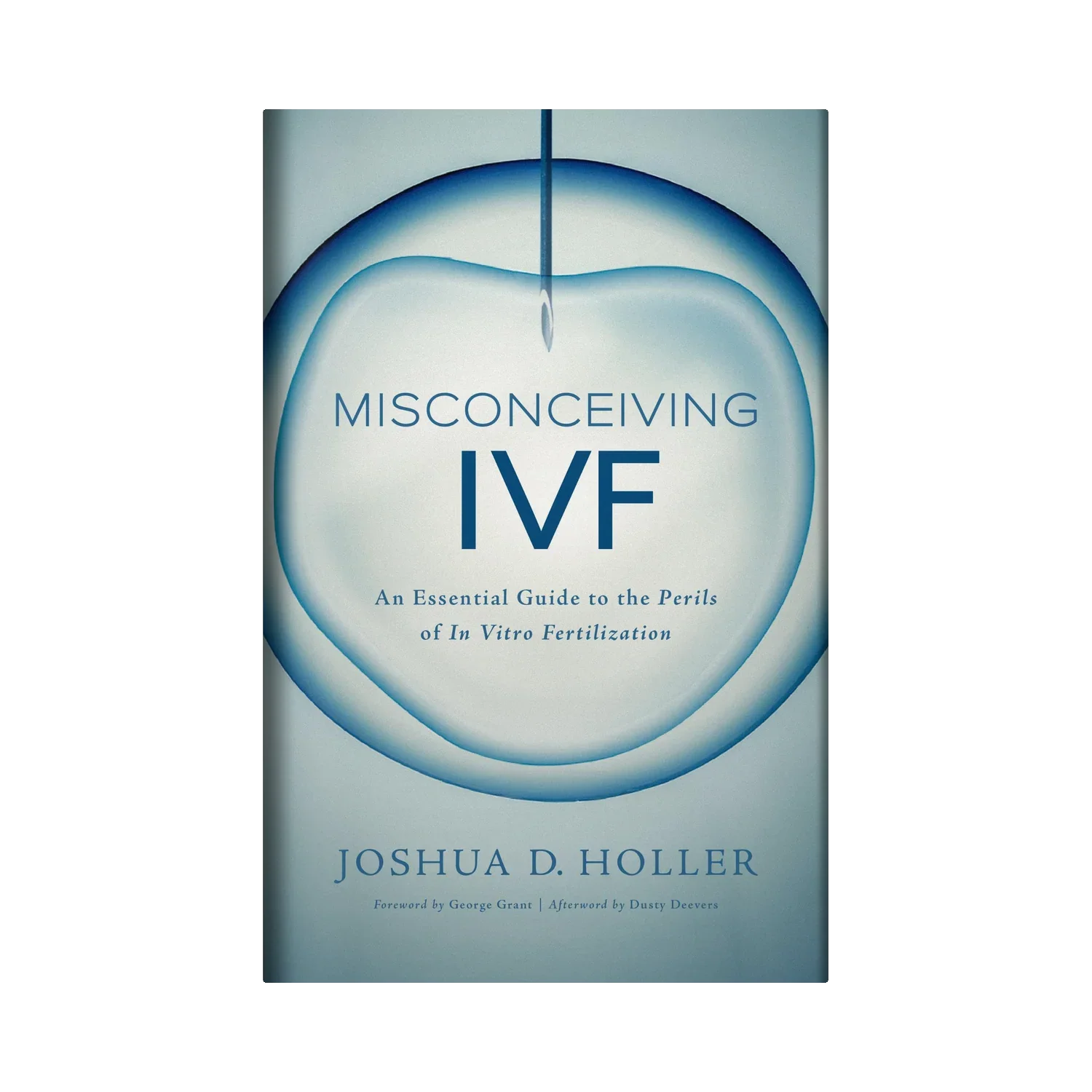
As a fourth installment of what has evolved into an ongoing series addressing Scripture, marriage and new technology, my alarm continues to increase as it relates to discordant thinking and apparent indifference to Scripture -- in particular with Reformed Baptists and Reformed ministries. I am beginning to come to the opinion that we are witnessing a creeping progressivism.
From recent years of studying marriage through a Genesis lens -- the chapters from which a picture of marriage is painted, resplendent with beauty to the glory of the Giver -- the profundity of this relationship is beyond scientific understanding. The specificity of this creational institution, from which humanity is built upon, can only be missed by willful intent.
From a new scientific technology comes a reimagined marriage: A family designed for a new age to include artificially conceived children with no anthropological connection to the husband, wife and their family. The Genesis man and woman as husband and wife in an exclusive one covenantal union is a thing of the past. Today, marriage must accommodate modernity.
Cultural discipleship has moved from redefining man and woman to reshaping Christian marriages. Married couples must now sync their worldview to accommodate an evolving technological understanding and avoid taking Genesis too literally, as though it does not speak to real life. In this way, an alien cultural norm is being introduced into biblical marriage and accepted as though it were compatible with the creational order: That of birthing someone else's children.
As a long-time listener and supporter of Founders Ministries The Sword and The Trowel, earlier this year I learned of a soon-to-be-released book covering In Vitro Fertilization (IVF) that included a section addressing leftover embryos. Having spent many many hours in research, writing and discussions regarding leftover embryos and Christian marriage, this naturally piqued my interest.
The focus of this article will include sections of this book. As such, it is not intended to be a comprehensive critique, but rather to draw out examples of why Genesis and marriage in the Church must be defended against the discordant thinking and postulates of man—even Christian men.
When the book arrived (July 2026), I read it through over two evenings. The forward written by George Grant included an excellent reference to Genesis chapters one and two with this clear statement: "God's perfect design is described in a series of mandates of ordinances. These defined the world as God intended it."
Further down the page he continued, "He made man both male and female," responsible for "filling up the earth with their progeny, with their children, grandchildren, and great grandchildren" (p. xiv). Grant's statements remained on the forefront of my mind as I continued to read.
Presuppositions
Here it is necessary to briefly state my presuppositions. For the sake of space, please follow this link and scroll down to Baseline for a fuller treatment. These presuppositions constitute the wonder of Yahweh God’s creational order and norm. Yahweh is a God of precision. There is an exactness to the Genesis account in how He established the foundation and institutional mold for marriage.
Christians who will not uphold this institution as prescribed in Genesis will not, in turn, fully uphold the anthropology of man—his essence, purpose, and being—including what it means to be male and female, the right relationship between male and female, and the purpose of procreation. The being, essence, and purpose of man and woman are inextricably woven into marriage and family.
When creation was pronounced “very good” (Genesis 1:31), it was not at the creation of man, nor at the creation of woman: Creation became whole and very good when God wedded the man and woman, thus establishing the first marriage, a once-for-all-time foundational relationship designed to fulfill the dominion mandate and the command to “be fruitful and multiply, and fill the earth” (Genesis 1:28). These were given through the first Adam and upheld by the second Adam for all humanity.
A compelling note: "God created marriage in the visible world to signify a bigger plan that eternally preexisted both marriage (and sin!)." The marriage of man and woman "enable them to participate in a visible depiction of God’s plan from eternity past to unite Christ to his bride" (Chase Krug – Science Can’t Tell Us the Most Amazing Things About the Human Body).
In time and space, this institution entered the world in purity and goodness, for the glory of God and man. It is, therefore, perfect in design and innocence. This order is permanent and unchangeable.
Whereas marriage encompasses the many subjects dominating today’s internet and podcast conversations regarding gender, masculinity, femininity, and proper sexual relations, these subjects find their definitive meaning and central purpose -- and ultimately culminate -- in the creational order of the marriage institution.
Thus, a fully normal and proper understanding of these must have a proper theological anthropology of marriage as the foundation -- the formational source and origin -- for understanding what it means to be human. This is the fundamental building block that anchors man to his humanity.
This is what the Genesis account provides.
For these reasons, the institution of marriage is a cardinal doctrine of the Christian faith (cf. 2 Corinthians 11:2). This gives no room for compromise or exceptions. An ardent defense is not only Biblical, it is a command (cf. Mark 10:2-9; Hebrews 3:4).
Pause Here
For the remainder of this article I will make reference to marriage as prescribed by Yahweh God and how He established it as His creational norm without going over ground previously tilled. Since I have refined my position in detail, I ask you to cognitively engage with an open Bible in these two articles, both written before Misconceiving IVF was released: Artifice Sex and Marriage Purity and Marriage and Techno Trojan Horse - Anthropology Matters.
Book Premise
From his introduction to Misconceiving, Pastor Holler describes his emotional and intellectual journey to his present-day understanding. It was interesting to note that his "tipping point" that moved him from initial acceptance to his rejection of IVF came when he understood the scale of embryonic destruction and embryonic life placed in cryogenic storage.
Page 21 states the book's premise: "The final chapter of this book argues [embryo] adoption is not just an option to consider . . . this is a vital mission that the church must be about." And, "adoption is a parable of the greatest adoption story ever -- the gospel." This explains why nearly one-third of the book is devoted to the topic of leftover embryos. Parts 1 and 2 lay the groundwork as a lead-up to part 3.
What Is This Book About?
The focus and intensity of the emotion involved regarding the horrific outcome of man's sinful pursuits with IVF cannot be ignored -- that of death and leftover embryos. Yet, with many writers who attempt to address this sin, it is here they go off the rails. Part 3 of Misconceiving is the most recent example.
Of necessity, one must keep in mind, particularly when reading Part 3, that what is being discussed and promoted deals intrinsically with marriage. When the author boldly states, "the Church must mobilize" (p. 128), he is speaking to married couples. Because the Church itself has no means to give life to an embryo, this means he is talking to young, child-bearing-age Christian couples -- they must take action -- they are the biological solution -- and they are needed to fix this problem.
Holler, as well as writers before him, however, wants us to think the plight of leftover embryos is the main issue they address. This leads him to this ideological statement: "We must do something about it," a conscience-binding statement that attempts to place a moral obligation upon the reader. What follows is a "walk through the process of embryo adoption" (p. 128) for married couples.
Adoption - A Biblical Definition
Regarding the hermeneutics of Scripture, the student is to draw meaning out of the text: Words matter, the definitions of words matter, the context of words matters, how a word is used matters, and the contextual framing of a word within the broader scope of the text matters. In short, what meaning did the divine Author intend? Is the word being rightly divided (cf. 2 Timothy 2:15)?
This book's failure begins with its lack of precision in handling the text of the Word, and that of reshaping words in order to obscure or add meaning in pursuit of a desired end. All of this is in play when one word becomes a focal point and the basis of a theological argument. In this case, it is the word "adoption."
The word "adoption" is used in the New Testament five times, all of them by the Apostle Paul -- Romans 8:15, 23; 9:4; Galatians 4:5; Ephesians 1:5. The main question for our purpose is, who are those receiving "adoption"? With this in mind a brief survey of Paul's writings will be helpful.
Romans 8:15 - Paul provides a simple contrast between two peoples, those in "slavery" and "fear" contrasted to those "adoption as sons" -- a people who profess faith and joy, "by whom we cry out, 'Abba! Father!'”
Romans 8:23 - Here, Paul addresses how "we ourselves groan within ourselves" while waiting for "our adoption as sons." He employs emphatic rhetoric that refers to individual people -- believers who "eagerly" long for with sighs and prayers to the final "redemption of our body.”
Romans 9:4 – Paul speaks of his brothers and kinsmen "who are Israelites, to whom belongs the adoption as sons, and the glory and the covenants and the giving of the Law and the temple service and the promises."
Ephesians 1:3-6 - Paul calls God "blessed." Why? Because He has "blessed us . . . in Christ." And "He chose us." And in love He predestined us "to adoption as sons."
Galatians 4:5-6 - Here Paul is specific: God sent His Son "so that He might redeem those who were under the Law." Those whom He redeemed will "receive the adoption as sons." And what will the adopted sons' response be? "Our hearts, crying, 'Abba! Father!'"
The redemption Paul speaks of is of people, and it is his pattern to include himself: "that we might receive the adoption as sons." Because he and others "are sons," from which comes the heartfelt cry, "Abba! Father!"
Is Paul merely writing in allegorical terms or using metaphors? Was his intent that the reader understand adoption in these verses as figurative? Or is he intentionally and specific regarding the identity of the adopted sons? The answer is clear in the contextual framing.
All of these are salvific in their given context. It is understood that Paul speaks of born people with a certain level of mental and physical maturity. It is people that Christ redeemed in order to become adopted sons, of whom he includes himself.
The obvious point: People are persons consisting of body and soul, with some level of intelligence and awareness of their being. Persons aware of their redemption and adoption have the ability to respond with "hearts, crying, 'Abba! Father!'" These are cries of individual persons who know they now have a new relationship, not as a "slave" but as a "son." There is, therefore, an awareness of their salvation and adoption.
In its sum, Paul has clearly defined to whom he wrote these letters -- to a people who are adopted sons -- the same people who will read these letters (cf. Galatians 1:2-5).
Regarding the word "orphan," the same contextual understanding must apply. The word "orphan" is used at least 25 times in the Bible, depending on translation. In the majority of occurrences, it is used in relation to "widows," therefore, fully formed people.
Adoption -- A Historical Definition
The present-day common and historical understanding of the word "adoption," when used in the context of children, refers to a child -- perhaps an infant -- a young person who can be held in one's arms or whose hand you may hold. They are fully developed persons outside the womb. Here are some examples:
Noah Webster on "adopt" and "adoption": The act of adopting, or the state of being adopted; the taking and treating of a stranger as one's own child. To take a stranger into one's family, as son and heir; to take one who is not a child, and treat him as one, giving him a title to the privileges and rights of a child.
Merriam Webster on "adopt" and "adoption": to take (someone or something) by choice into a relationship. To take (a child born to other parents) voluntarily as one's own child.
Etymonline (etymology) of "adopt" and "adoption": Originally in English of friends, fathers, citizens, etc., as well as children. mid-14c., adopcioun, "action of taking (a child) as one's own; condition of being adopted.
Scottish Presbyterian Matthew George Easton on "adoption": "Adoption, [is] the giving to any one the name and place and privileges of a son who is not a son by birth."
Adoption is naturally understood as persons -- even in recent times -- as infants, children or older. These are the ones on the outside being brought in and placed into a new relationship.
Going further back than the 14th century, consider the historical Biblical cases, Pharaoh's daughter, taking a born baby whom she named Moses (Exodus 2:10), Mordecai taking in Esther -- likely an older child (Esther 2:7) and Jacob adopting Joseph's two sons Manasseh and Ephraim (Genesis 48:5). All are historical examples of adoptees being born persons brought into a household who were not a son or daughter by birth.
History is consistent with Scripture. Why? Because the Bible first defined the word thousands of years ago.
Adoption -- A New Definition
In the late 1990s, Nightlight Christian Adoptions invented a new label, "embryo adoption." This was a common yet deliberate method of relabeling, used to redirect or expand a person's thoughts and perceptions.
Paige Comstock Cunningham writes:
"Labels also may reveal a great deal about motivations and can be used in an attempt to increase or decrease the value of someone or something."
Inventing a label was necessary to reshape and replace words that sounded like a biological commodity, a clinical procedure, or an abstract lab process -- words that were too impersonal, such as "test tube", "zygote", "donation", and "transfer". These were replaced with more acceptable and appealing-sounding words to alter perception and to cause one to engage their emotions and sense of compassion.
During these years, Nightlight Christian Adoptions also introduced "Snowflakes®" as the label to describe their embryo adoption program and registered it as a trademark. This became Nightlight's marketing campaign and was supported by approximately $500,000 of taxpayer dollars provided by the Federal government in order to promote this new program.
From this starting point a handful of years ago emerged a new definition based on euphemisms -- the reshaping of the word "adoption" to now include embryos. At this point a theological novum emerged, one that Misconceiving embraces and is predicated on this reshaped word. By necessity, a new expanded meaning of adoption was created in order to fit a new theology into Scripture.
This theology comes into clear view on page 21, where this new definition is assumed and he states: "Adoption is a parable of the greatest adoption story ever -- the gospel." Subtly, a moralistic equivalence is applied; but not until many pages later does it become evident that he is employing this new definition. Symbolism and virtuous-sounding language is introduced early, preparing the reader to accept the author's ideology and the theological framework that follows.
Adoption - A Technology
The title of chapter 7 asks a question, "What Do We Do with Leftover Embryos?"
A brief note: An embryo is when sperm and egg are combined in a glass dish and conception occurs. The leftovers are simply the ones not going to be used.
The author answers with this authoritative statement: "I've formed a moral appraisal" (p. 124). With self-determined authority, he continues: The Church is to "champion the adoption of these little children" (p. 125). What is he speaking of? Here, the euphemistic labels are used: "Embryo adoption, also known as snowflake adoption, is a morally permissible option for couples, though it falls far short of God's design and ideal" (p. 127).
Embryo "transfer" is part of the IVF process – that of injecting an embryo into a woman's womb. Snowflake adoption uses this process. At this point a few important questions must be laid on the table in order to understand what is involved in snowflake adoption.
1. What is actually is being adopted?
2. What is the church to champion, what is actually being advocated?
3. What is necessary in order for couples in the church to carry out this "vital mission"?
The author's answers are revealing.
To begin to uncover these answers, it is necessary to take a look at statements made by Holler in earlier chapters. Follow closely and clarity will follow.
Beginning with chapter 3, The Loss of Life chronicles how IVF "destroys more lives than it creates" (p. 44 emphasis added). Later we will see that statistics bear this out, with specific reference to the embryo transfer step of IVF. Here Holler states:
"When the transfer of an embryo does not result in a pregnancy, it still involves a death of an intentionally created embryo" (p. 53 emphasis added).
The death he speaks of is the result of the high failure transfer rate of this technology. The author then doubles down in order to make sure his position is clear as to what is at stake when attempting pregnancy using IVF:
"It would not be right, because even a single failure [referring IVF embryo transfer step], resulting in the death of a human being, would have occurred because of the volition of the couple" (p. 55 emphasis added).
To be clear he states:
"The loss of life is the greatest reason why we should oppose IVF" (p. 57 emphasis added).
A few pages later he summarizes:
"What routinely takes place in the practice of IVF has its hooks in more of our lives than we may desire to admit or know. Far too many of us are complicit in this evil and tragically, silent about our participation in something that is morally compromising" (p. 62 emphasis added).
Next, consider these statements, that using IVF is a deliberate choice:
"There was the purposeful and willful act to pursue IVF. A "willful act to exceed the boundaries of the one flesh union" (p. 55 emphasis added).
Later he clarifies, a "confounding reality . . . couples can now have children without sex" (p. 89 emphasis added).
He then doubles down with a positive statement:
"It is within this union alone that the one-flesh act of cleaving can be pursued with God's blessing" (p. 93 emphasis added).
Here Holler is to be commended for a definitive statements as to the evil of IVF. But, it is also here with his own words, he paints himself into a corner. These statements answer all three of the above questions.
1. What is actually being adopted?
Adopting the technology of IVF. Snowflake adoption uses IVF's embryo transfer process – that of injecting a foreign embryo from strangers into a married woman's womb. The very technology the author has stated is "evil."
2. What is the church to champion, what is actually being advocated?
The church is to champion the use of IVF to Christian couples. The same IVF that is "evil" and "destroys" life and is therefore "morally compromising".
The "adoption" the author speaks of cannot occur without IVF embryo transfer.
3. What is necessary for couples in the church to carry out this "vital mission"?
"We live in an age that is accustomed to sex outside of marriage. . . . this was never supposed to be normal. . . . Yet here we are confronted with an equally confounding reality . . . couples can now have children without sex" (p. 89 emphasis added), which the author earlier stated is a "purposeful and willful act to exceed the boundaries of the one flesh union" (p. 55 emphasis added).
Here the confusion is palpable. Remember, according to the author, snowflake adoption is "morally permissible." His inconsistency, and what he fails to point out, is that this is the same attempt to have "children without sex" which was "never supposed to be normal." Except the author has previously claimed, "the natural way God's creatures are to fulfill the creation mandate to be fruitful and multiply is through sex" (p. 100 emphasis added). So which is it?
To perpetuate this confusion further is this quote: "departure from God's intention for a proper one-flesh union or attempts at circumventing His design lead to terrible consequences" (p. 98 emphasis added). But remember the author also stated, "Embryo adoption, also known as snowflake adoption, is a morally permissible option for couples, though it falls far short of God's design and ideal" (p. 127 emphasis added). So which is it?
Here is a concise summary: In order to "adopt" a snowflake embryo, IVF (an "evil" technology) must be adopted. The church is to champion it, and couples are to embrace this "morally compromising" technology that bypasses God's "natural" creational design by attempting to create "children without sex."
Clinic Carnage
Here we must remember one very sobering point that should not be overlooked. The author has clearly stated that when an embryo transfer is attempted and fails, it results in "death of a human being." IVF, then, destroys life.
The table on page 49 demonstrates just how much life is destroyed. Doing the math reveals a 54.4% embryo transfer death rate. Because of the "volition of the couple" (p. 55), they will likely be complicit in death.
To sharpen this point, a Christian embryo clinic states: "More than 160 babies are expected to be born through the program in 2026, making a total number of over 1,600 Snowflakes Babies born!" (Why Snowflakes). Using CDC math percentages from page 49, to achieve that number means that at the very least, 1,908 failures have occurred since the beginning of the Snowflakes® Embryo Adoption program.
Let that number sink in.
Recall the author's words: "Even a single failure" results in the "death of a human being."
Christian couples have therefore been complicit in one thousand, nine hundred and eight deaths!
Further, this number is most certainly understated. The common IVF practice is to prepare two embryos in case the first one dies during transfer. Which is not even to say that the second embryo may not have also died during the transfer attempt, and those are not counted at all. Neither does this account for those who never make it to the transfer step, who die leading up to the transfer, or who die during the transportation or the thawing process.
So, the actual number of deaths is unknown and is, more likely than not, much higher. And these numbers come from just one "Christian" clinic.
In light of this reality, astonishingly we read: "Decisions will arise . . . whether to try more than once if a first attempt fails" (Misconceiving IVF p. 138). This should send chills down a Christian's spine. Is not "failure" the death of a person?
How can this be? How can a Christian tell another Christian that this is permissible, when they will likely take part in the death of one, two, and perhaps more little lives in an attempt to get a baby? How is this protecting a vulnerable person at their greatest degree of dependency?
One couple states, this will be their "second frozen embryo transfer (our first transfer was unsuccessful)." And this "Snowflakes costs and medical costs will be about $24,000-$30,000" (Andrew and Jennifer). We must understand what is going on here.
Did not this couple previously pay $24,000 to $30,000, only to have the process end in the death of one, perhaps two, human lives? With a 54.4% death rate, what are they likely to achieve after spending $48,000 to $60,000? Is this simply the price to be paid for a hoped-for result?
What we now have is another necessary euphemism in order to disguise death of a person as simply "unsuccessful."
Here at this point, let us address another question the author asks. He prefaces his question with: "Blind spots emerge in our thinking often because of the culture we live in" (p. 89). Then he asks, "do I have a blind spot?" (p. 90).
What Is A Blind Spot?
To address this question, we must ask "what does a blind spot look like? Imagine this scenario involving two married woman.
The first woman:
With money pays a fee. A frozen embryo is selected for grade or quality and other desirable traits. She subjects her body to numerous pharmaceutical injections in an unnatural attempt to make her body accept the embryo. She arrives at the clinic, lays on a table where a technological, sexual procedure is performed by a doctor to transfer the embryo through her vaginal canal into her uterus. This completes the IVF transfer process.
The second woman:
With money pays a fee. A frozen embryo is selected for grade or quality and other desirable traits. She also subjects her body to the same numerous pharmaceutical injections, arrives at the same clinic, lays on the same table where the same technological sexual procedure is performed by the same doctor to transfer the embryo through her vaginal canal into her uterus. This completes the snowflake adoption process.
Have not both women used unnatural drugs in attempting pregnancy? Have not both women allowed the involvement of a third party (the doctor) to replace her husband in procreation? Are not both attempting to abnormally have a child without sex?
What both women willfully submitted to is exactly the same. Yet, the blind spot says the first woman has participated in morally compromising evil. Whereas, the second woman has participated in something morally virtuous.
Both women paid money to get an embryo and both women chose the embryo that best suited them. Yet the blind spot does not recognize that both women have commodified human life.
Here it must be pointed out that the third party sex act of combining sperm and egg in a glass dish carries over when another third party injects that fertilized egg (embryo) through the woman's vaginal canal into the her womb. Both woman participated in something "utterly alien to God's design" (p. 89).
Are either of these scenarios "fulfilling God's intended means for having a child?" (p. 99). Obviously not. "God's boundaries around marriage and the one-flesh union include how He intends for His creatures to reproduce. The introduction of a third party into the act of sex is never envisioned in Scripture" (p. 99 emphasis added).
By way of note: Before you point the finger and say "straw man," do your homework. The steps in these scenarios are factually accurate. An embryo transfer is an embryo transfer, and attempting to separate one transfer from the other is, on its face, dishonest.
A proper and honest understanding is this: Someone -- we will assume a couple -- begins the IVF process and completes the initial steps. The process is then paused after the embryo creation stage, for whatever reason, with no intent to complete the final steps. A Christian couple then intervenes as surrogates, replacing the biological parents, and simply continues and completes the remaining IVF process, which ends with the embryo transfer into the replacement womb.
The fundamental blind spot in this book is the compartmentalizing of IVF. IVF must be understood as a whole, each step is the same across the entire process. The steps required from beginning to end are exactly the same. The changing out of the woman at the end who receives the embryo transfer does not change the nature of IVF.
Adding creative, virtuous-sounding euphemisms to the end steps of the process does nothing to sanitize the nature of IVF. All the issues, risks and immorality of IVF do not change simply because a different person (Christian) finish the process.
This is not medicine, this is artificial sex to unnaturally create and get a baby.
Because of the author's blind spot in Misconceiving, he has attempted to build a mental and theological firewall between IVF embryo transfer that he calls "snowflake adoption." Which is nothing more than a relabeled IVF embryo transfer. This distinction is necessary to avoid moral jeopardy and discrediting his own "moral appraisal" given on page 124, as well as to avoid implicating Christian husbands and wives who have willfully participated in a morally compromising procedure.
Attaching different labels does not change the facts. This technology is immoral from beginning to end, regardless of what you call it. This is wishful, intentional blindness.
Antithetical Pursuit
The antithetical nature of this book is unavoidable. Right in the middle of IVF technology, the author has erected a faux firewall, created to insulate himself from advocating immorality and from ignoring the divine specifics of the creational order established in Genesis 1 and 2. Notice the selective application of Genesis to parts 1 and 2 of this book -- but not to part 3. This is a false division because the author wants us to believe we are responsible to "do something".
It is astonishing to realize that "you shall not murder" (Exodus 20:13) is not considered relevant. What is being promoted and sanctioned in Part 3 of this book results in more death, and that at the hands of Christians. Read the author's own words: "They are participating in an industry that routinely creates and destroys life. Why participate at all? Why go near it?" (p. 57). EXACTLY!!
Holler unwittingly commits a logical fallacy – what is evil, cannot be not evil. Black cannot be not black. Evil technology cannot become not evil technology simply by changing the person who uses it.
The failure here is not understanding the origin and ungodly intent of this technology. IVF technology is necessary in order to undertake a snowflake adoption. This technology is not some "impressive story of human ingenuity and scientific achievement" (p. 46). It is a story of wickedness – and what was achieved is evil.
The Gospel
Now we arrive to where the lowest depths are plumbed. Snowflake "adoption is a parable of the greatest adoption story ever -- the gospel." The antithesis here is striking. What began with redefining one word has progressed to creating a new theology, and now we are presented with a made-up parable. A change in terminology has now become a theological framework that attempts to reshape the meaning of biblical adoption itself.
The author has not heeded his own warning: "The way we communicate can sometimes veil or downplay certain aspects of the reality that truth is connected to. When euphemisms abound, we often forget the weightiness of what we are talking about" (p. 11).
The author's adoption parable is founded on euphemisms. This was needed to force an equivalence into the gospel. In other words, such an equivalence did not come from the Word, it was imposed on the Word. Is this not using gospel language "to steer churches and steer Christians in directions that are contrary to the way of Christ" (Why is Law and Gospel Important?)?
Christ, who did not abolish the Law, rather fulfilled it in all righteousness in order to save and adopt a repentant sinner (cf. Matthew 3:15; 5:17), upheld the creational order of Genesis in every way (cf. Matthew 19:6; Mark 10:6-9). How then is abandoning the Law of God – His ordained prescribed and blessed means of procreation – and complicity in the death of other people comparable to the Gospel of life?
The true testimony of the gospel is marriage lived out as designed – a redeemed husband and wife redeeming marriage with their hearts' desire to abide by God's covenant, prescriptive Word and procreational command.
In the end, what Misconceiving is promoting is … IVF. This, by way of a self-legislated moral imperative not found in the New or Old Testament. Since IVF is wrong for its violation of God's design and command regarding the one flesh union, including complicity in death; then using IVF to "snowflake adopt" cannot be right. Evil does not become not evil because Christians are involved – regardless of motive. Therefore, IVF in all its uses must be considered a violation.
Must We Do Something?
As a continuation of this series of articles, I will address in a near future article, the abandonment of embryonic life in light of a sovereign God who is both Lord over life and death, and the finished work of Jesus Christ on the cross. We are given every reason for hope and we are given every reason to trust.
God's glory will never give way to the wickedness of man. Not one life is beyond His reach regardless of how it was created. "Salvation belongs to Yahweh" (Jonah 2:9).
Final Word
It is sad and troubling to read a reformed pastor who wrote such an unreformed book. What happened to Tota Scriptura and Sola Scriptura? What happened to drawing meaning out of the text of Scripture? What happened to Yahweh God's exhaustive foreknowledge and sovereignty? Does He or does He not work all things according to His purpose (cf. Romans 8:28)?
Reformed theology is consistent in its understanding and application of the text and does not treat sacred Scripture as a playground of words. When the limitless relevance of the Word is forgotten, it leads to an unthinking compassion that advocates a praxis that certainly is not pro-life. It can't be.
God's marital covenant and institution, given by way of His legislative, executive, and judicial authority, are not mere suggestions. Sentimental theology wants us to reimagine marriage. It will stretch the truth, toy with words, make foundationless moral claims, and suggest that there is a "plan B" if God's ideal cannot be met.
And yet, Genesis declares: "God's perfect design is described in a series of mandates of ordinances. These defined the world as God intended it." Regarding marriage, "He made man both male and female," to procreate, "filling up the earth with their progeny, with their children, grandchildren, and great grandchildren," not someone else's (Grant, emphasis added).
Instruct me, O Yahweh, in the way of Your statutes,
That I may observe it to the end.
Psalms 119:33
Antithetic Pursuit - Epilogue – Semper Reformanda?
Addressed here is the downgrade of Reformed Baptists and the publisher’s unwillingness to dialog concerning Biblical issues found in this book.